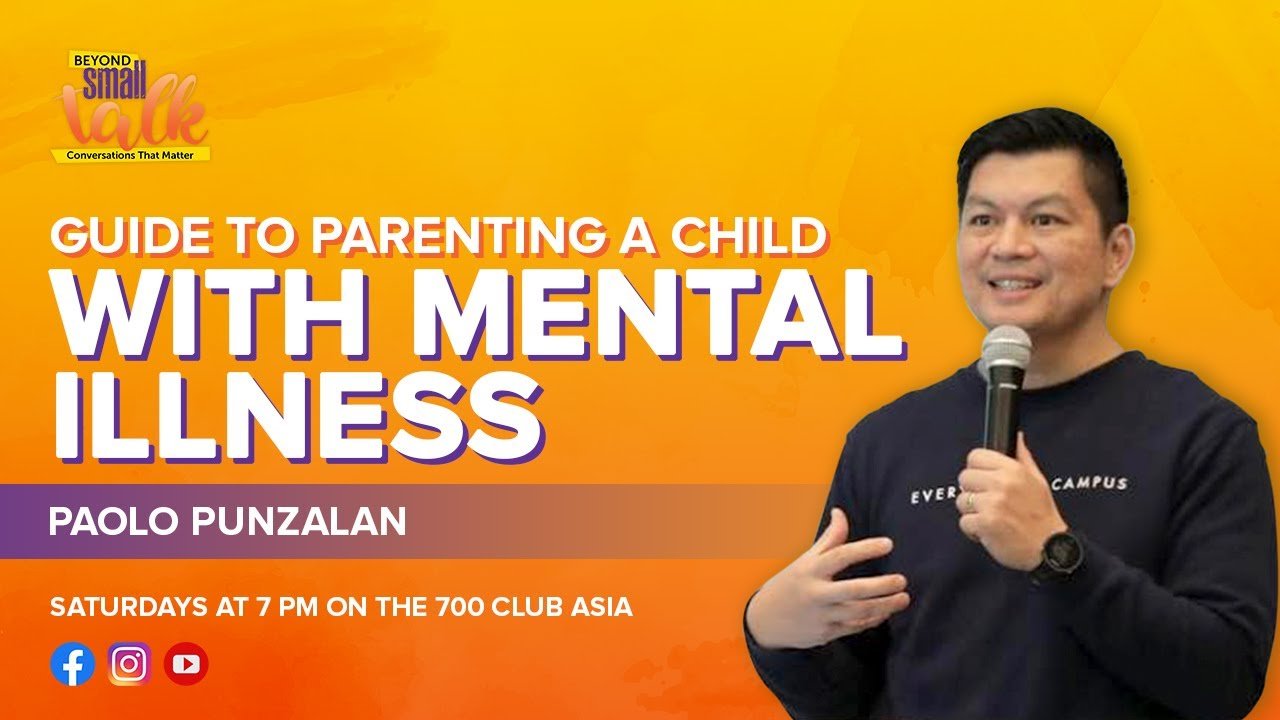
6 Tips for Parents with a Child Struggling with their Mental Health

No parent ever wants their child diagnosed with a mental illness.

But the truth is, mental health disorders know no age. It could happen to anyone, even to young children, teens, and older adults. Knowing what to do to help their child struggling with their mental health is a big challenge for most parents.

If you’re wondering how you can support your child, Beyond Small Talk guest Paolo Punzalan shares 6 parenting tips to help your child on their mental health journey:

Tip #1: Make your home a safe space for your children

Everyone needs a safe place to flourish. To fully support your child, make sure that your home is a safe place to come home to – both physically and emotionally.

Assure your child that you are willing to understand and listen to their concerns. Start a conversation, and allow them to open up when they want to or when they’re comfortable.

“I tell my children that no matter what happens, they can always come home. Our home should be a place where they can be themselves. That doesn’t mean we won’t discipline or put boundaries. But it should be a safe space. So we listen, we validate. Sometimes we just hug them and not force them to talk,” Paolo shared.

Tip #2: Don’t take things personally

Does your child keep ignoring you? Do they seem rather irritated and a little less than friendly?

Don’t take it personally. Symptoms of mental illnesses differ from one another, but they all affect how your child respond to their environment. Use empathy, not argument.

Paolo recalled, “That became my problem, too. I took it personally. I’d tell them, ‘Why don’t you talk to me? I want to help you but you’re ignoring me!’ It was painful, but we just really need to be there. Those were some of the lessons I learned as my children went through different things during this pandemic.”

Tip #3: Turn to God

No matter how you try to carry everything on your own, you can’t do it all alone. There is no need to be overwhelmed. You can always pray and seek God’s strength, hope, and comfort for you and your child.

“If we love our children, God loves them more. We can surrender all our worries to God,” Paolo reminds.

Tip #4: Be very patient

Looking after anyone who is struggling with their mental health can be physically and emotionally draining. If you find your patience being tested, take the time to think about what your child is going through and remember to take care of your own mental health, too.

Paolo has a suggestion for you, “I know sometimes we want to question them why they wouldn’t talk to us or  even want to eat. But that’s not the time to correct them, it’s a time to be patient.”

Tip #5: Ask for help

It’s good to ask for help. Sometimes, people want to help you and your child, but they do not know how. Give people the opportunity to bless you however they can.

Likewise, Paolo encourages you to seek help from doctors and mental health professionals, “Mental health problems are treatable. I know there’s a stigma, but God can bring healing. If there’s a need to go to a professional, it’s perfectly okay to go to a counselor or a psychiatrist.”

Tip #6: Be present

Every parent should be intentional about “Present parenting.” It’s challenging, but don’t just find time—make time for your child. And whenever you’re together, it’s best to give them your undivided attention.

“More than anything, be present. Love them unconditionally. Tell them, ‘No matter what happens, anak, I’m here. I will love you.’

As you connect with your child, gently connect them to Jesus, too. Everyone—including you and your child—will go through challenges in life, and you can’t be around them 24/7, forever. But when they get to know God, He can guide them.

Be present, pray, and teach your child that they can turn to God every time.

Is your child struggling with their mental health?

Allow us to comfort you through prayers. Feel free to call the CBN Asia Prayer Center at 8737-0700 or send in your prayer requests to our Facebook page.

For more meaningful content, catch the brand new webisodes of Beyond Small Talk every Saturday, 7:00 PM, on The 700 Club Asia Facebook page and YouTube channel.

3 Questions to Ponder about All Saints’ Day and All Souls’ Day

It is the time of the year again when you, together with your family, traditionally gather at cemeteries to visit the grave of your loved ones.

In the Philippines, it is also the time when the working people have the 1st of November as a holiday from work while, with November 2 as a working holiday.

But apart from knowing All Saints’ Day and All Souls’ Day as events on your calendar, have you ever wondered about the origin, biblical perspective, and the proper Christian way of dealing with these holidays?

Here are 3 questions and answers to ponder about these holidays:

What is the difference between All Saints’ Day and All Souls’ Day?

According to an article on BBC, All Saints Day is a time for people to remember the known and unknown saints and martyrs in history. The holiday is also known as All Hallows Day or Hallowmas.

Encyclopedia.com defined All Saints’ Day for the West as the feast observed on the first of November. For the people in the East, it is observed on the first Sunday after Pentecost.

Meanwhile, All Souls’ Day according to Christianity.com, is the day when people commemorate the souls of those who died already.

Crosswalk.com explained that the Roman Catholic Church and Eastern Orthodox churches set November 2, a day after All Saints’ Day, for this observation.

The article continues that the observation of All Souls’ Day entails the Roman Catholic Church’s belief of praying for those faithful departed Christians who might need to undergo the process of cleansing before they can set foot in heaven.

What does the Bible say about All Saints’ Day and All Souls’ Day?

When you think of saints, you probably first thought of the statues of saints displayed in Roman Catholic Churches and of the fiestas celebrated in different places in our country.

But as mentioned earlier, All Saints’ Day is a day to commemorate all saints – known and unknown. Who are the saints?

It is you and the rest of the Christian believers.

“To the church of God at Corinth, to those sanctified in Christ Jesus, called as saints, with all those in every place who call on the name of Jesus Christ our Lord—both their Lord and ours.” (1 Corinthians 1:2 CSB)

Every believer who accepted Jesus as Lord and Savior and who trusts God alone is a saint in the eyes of God.

So, as you observe All Saints’ Day this November 1, remember that this celebrates the unity of Christian believers in Christ Jesus.

On the other hand, All Souls’ Day is a day to pray for the cleansing of your departed loved ones. This purification is set to help them enter heaven, known to be purgatory.

However, purgatory — or the concept of it — is not found in the Bible. For those who died, their destination is either hell or eternal peace with God in heaven.

It is only through Jesus Christ that you can attain the forgiveness of your sins and the assurance of being with God for eternity.

“My dear children, I write this to you so that you will not sin. But if anybody does sin, we have an advocate with the Father—Jesus Christ, the Righteous One. He is the atoning sacrifice for our sins, and not only for ours but also for the sins of the whole world.” (1 John 2:1-2 NIV)

To sum up, from the article by Compelling Truth, it is unbiblical for Christians to practice praying to for the souls of their dead or laying out food for them during All Souls’ Day.

So what could Christians do during these holidays?

All Saints’ Day and All Souls’ Day should not be a waste of your holiday time.

You can see these days as opportunities to worship God. Use this time to seek God and hear from Him.

Secondly, you can reach out to your grieving family and friends because of the death of a loved one. Your empathy and encouragement can go a long way for them.

Lastly, use these holidays to take part in the great commission. Share the gospel with someone. By doing this, another friend, relative, or even a stranger can find eternal security in heaven after death.

“Go, therefore, and make disciples of all nations, baptizing them in the name of the Father and of the Son and of the Holy Spirit, teaching them to observe everything I have commanded you. And remember, I am with you always, to the end of the age.” (Matthew 28:16-20 CSB)

Do you also want to spend eternity with the Lord after death? Begin your journey of faith today.

If you have any questions about the biblical perspective on these holidays, you may call the CBN Asia Prayer Center at 8-737-0-700 and we would love to guide you and pray for you!

What are You Thankful for Today?

If you’re having a hard time answering that question, you are not alone.

Some people feel that they don’t have much to be grateful for during the pandemic because of its impact on their health, jobs, and relationships. These days, it takes tremendous strength to be grateful and say, “Thank God.”

So, how do we hold on to gratitude even when times are tough?

Angie Garcia’s story is here to inspire you.

One day, Angie woke up with an excruciating pain on her left knee. Brushing it off as a simple leg pain, she endured it for two months until she couldn’t take it any longer.

When they rushed to the hospital, Angie found out that she had a torn ligament which required her to undergo an emergency surgery.

Suffering in physical pain, Angie was also mentally distressed about where she would get the surgery fee amounting to Php 100,000.

“It was painful. I couldn’t walk, I couldn’t move. All I could do was pray, ‘Please, Lord. I’ve had enough. This would’ve been my 11th surgery, so I didn’t want to go through it,’” lamented Angie.

Like Angie, have you ever come to a point when you’re frustrated about your situation?

How did you overcome it?

At her breaking point, Angie chanced upon The 700 Club Asia and the hosts were praying for someone who has a torn ligament. Deep down, she knew that the prayer was for her.

Angie joined the prayer without second thought. She remembered to trust God and thank Him for her life. She thanked him for the healing that she is yet to experience.

Angie recalled, “I prayed, ‘Lord, thank You! I claim that I will be healed!”

And it happened.

Angie felt instant healing right after the prayer. She immediately texted the program and expressed her gratitude, “I told them, ‘Thank you for your prayers.’ Then I claimed healing of my torn ligament.

Brimming with excitement, Angie went to have her knee checked by the doctor again. To her doctor’s surprise, Angie’s knee was well and healed!

“My doctor told me that my condition looked even better than before!” Angie said while smiling.

How about you, how do you remain thankful when you are going through a suffering?

Angie chose to thank God even before she received healing. She chose to believe that God is greater than her current circumstances. She chose to trust that He will always carry her through.

“The joy in my heart comes from the Lord. That’s the most important thing for me. The joy in my heart, His healing, His provision… everything — big or small— comes from Him. And I would like to thank Him for that,” Angie ended.

What are you grateful for today?

Being thankful isn’t easy in times of suffering. It takes faith to look beyond your current situation and look to God — the one who is in control of everything.

“Be anxious for nothing, but in everything by prayer and supplication, with thanksgiving, let your requests be made known to God; and the peace of God, which surpasses all understanding, will guard your hearts and minds through Christ Jesus.” (Philippians 4:6-7 NKJV)

Do you need someone to pray for you? Call the CBN Asia Prayer Center at 8-737-0-700 or send your prayer requests to our Facebook page.

If you are seeking God’s grace and comfort during these trying times, listen to “2AM Wide Awake,” an inspirational song by Neo Rivera and Jericho Arceo! The song is produced by Reverb Worship PH, CBN Asia’s music arm.

Watch the lyric video visualizer of 2AM Wide Awake on YouTube or stream it on all digital streaming platforms worldwide.

What is Sin?

You have probably encountered the word “sin” many times in your life. And perhaps, you even easily explain this word as a transgression to the law of God to people who ask.

Although you already have a general perception of the word sin, there is still a lot to know about it. So what is sin, really?

Here are some biblical truths that can give you an in-depth understanding of sin:

Origin of Sin

In the beginning, God made a perfect world and all that is in it. But then, Adam and Eve committed sin. You can read the account in Genesis 3.

Adam and Eve violated God’s command to not eat the fruit of the Tree of Knowledge of Good and Evil in the garden of Eden. They had the freedom to enjoy everything except that fruit, yet they did not obey the commandment of God and sinned.

 ”The woman was convinced. She saw that the tree was beautiful and its fruit looked delicious, and she wanted the wisdom it would give her. So she took some of the fruit and ate it. Then she gave some to her husband, who was with her, and he ate it, too.” (Genesis 3:6 NLT)

Here, sin clearly originated from the disobedience of man. Adam and Eve overruled the will of God in their lives by deciding to disobey Him.

Causes of Sin

But before their disobedience, it is also important to see that it was the lies of the enemy deceived Adam and Eve that caused them to sin in the first place.

Then the Lord God asked the woman, “What have you done?” “The serpent deceived me,” she replied. “That’s why I ate it.” (Genesis 3:13 NLT)

Even today, this is still happening to every person, to non-Christians, and much more to Christian believers.

The lies of the enemy are always around you, causing you to sin. This deception makes your heart to rebel against God and sin.

So, it is crucial that you guard your thoughts and heart against these lies at all times.

“Above all else, guard your heart, for everything you do flows from it.” (Proverbs 4:23 NLT)

Forgiveness of Sin

When you fail to guard your heart and eventually sin, you will die. As said in Romans 6:23, “For the wages of sin is death…”

But the good news is God will not let that happen to you. And as you continue to read the same verse, “…but the gift of God is eternal life in Christ Jesus our Lord.” 

God made a way to save you from this pit of unrighteousness and bring you back to His presence.

Through the blood of His son, Jesus Christ, you could have salvation and a new life, free from sin and shame.

God’s redemption is always available for you. The question is, are you willing to accept the salvation God freely gives you?

Call the CBN Asia Prayer Center today at 8-737-0-700 and experience a changed life in Jesus Christ!

How to Support a Loved One with Mental Health Problems – Beyond Small Talk

Mental illness could happen to anyone and it could be difficult to recognize.

Unlike a physical wound that is easy to spot, mental illness is an internal war hidden behind a smile, a hello, and the telltale phrase, “I’m okay.”

According to Mayo Clinic, some of the warning signs you should watch out for are “excessive fears or worries, or extreme feelings of guilt, significant tiredness, low energy, and inability to cope with daily problems or stress.”

If you recognize these symptoms in a friend, colleague, or family member, check out these tips from Beyond Small Talk hosts Peter Kairuz, Sonjia Kakilala and psychotherapist Alain Dizon to know how you can better support them in this journey.

1. Make the person feel that nothing has changed

You might feel awkward when approaching them, but try to relax. Make them feel that you’re the same person they have known and you still see them the same way. Create a safe place for them to unload and share their struggles without judging nor condemning them.

2. Ask them how you could help

It’s okay to be honest and to admit that you don’t know what to do. Ask them how you could help. Always take the cue from the person.

Tell them your limitations and boundaries when helping, but assure them that you’ll journey with them to recovery.

3. Learn how to listen

Avoid acting like an expert by trying to fix your loved ones’ problems. What they need are your heartfelt presence and listening ear to make them feel that you genuinely care.

Also, don’t force them to speak if they are not yet ready to open up. Just make yourself available whenever they are comfortable to finally talk.

4. Educate yourself

One of the biggest challenges that people with mental illness have to deal with is stigma. Educating yourself will help you to better relate to them and provide the best assistance.

Did these tips help you? Feel free to comment on the online discussion and make sure to catch the next webisode of Beyond Small Talk! Watch it next Saturday, October 23, 2021, 7:00 PM, on The 700 Club Asia Facebook page and YouTube Channel!

Also, we would love to pray for you and your loved ones who are suffering from mental health problems.

Call 8-737-0-7-00 if you’re in Metro Manila. If you’re outside Metro Manila or the Philippines, contact us through CBN Asia Prayer Center.

3 Self-Care Practices for a Healthier Body, Soul, and Spirit – Beyond Small Talk

Taking care of your overall well-being is integral to being a healthy and productive person.

It enables you to be more productive, it boosts your immune system, enhances your self-esteem, and improves your compassion towards others, says Katherine Hurst of The Law of Attraction in her article What Is Self-Care And Why Is Self-Care Important?.

But then, a lot of people still think that self-care is being selfish and inconsiderate.

In this webisode of Beyond Small Talk, hosts Peter Kairuz, Sonjia Calit, and Zenia Panahon discuss the importance of self-care. They also share tips that you can apply to have a healthier body, soul, and spirit. (https://publishedreporter.com/)

1. Learn to listen to your body

Are the pressures of life crushing you down? Swamped by your daily tasks and cannot function well?

Be sensitive to detect the messages that your body sends to you.

“Self-care is not being selfish, it is being healthy,” Zenia Panahon emphasized.

Can you hear your body groan and complain? It’s okay to take a step back and retreat.

2. Set aside some time for yourself

Stress is everywhere. It is inevitable.

You need to find some time to slow down, clear your thoughts, and get replenished. You may try meditating, take a 10-15 minute walk every day, or clean and declutter your desk.

According to Zenia Panahon, “Self-care routines vary for different people. It still depends on what works for you and what recharges you.”

3. Make a habit of spending time with God.

Dedicate a time for just you and God.

Say a word of prayer, give thanks to Him, and read what He wants to say to you through His Word.

You can come to God in all your brokenness. Allow Him to make you whole and to comfort you while in the midst of your raging sea of stress and negative emotions.

Peter Kairuz says it beautifully, “When God comforts you, it’s all-encompassing. It’s not just your spirit, but your body benefits from that moment with God.”

If you’re suffering from mental illness, Beyond Small Talk is here for you and ready to listen.

Do not hesitate to join our online discussion and share your struggles with us.

You may also call the CBN Asia Prayer Center at 8-737-0-700 and we would love to pray for you.

For more inspiring content and practical tips, catch the next webisodes of Beyond Small Talk every Saturday, at 7:00 PM at The 700 Club Asia Facebook page and YouTube Channel.

3 Tips to Sleep Better at Night

Still awake and can’t sleep?

You are not alone.

In an article by Sunstar.com, about 46 percent of Filipinos are experiencing sleep deprivation, and about 32 percent sleep less than six hours a day.

If you are one of these people who have a hard time sleeping every night, here are some tips that could help you achieve a good night’s sleep.

1. Have a regular sleep-wake schedule

According to HelpGuide.Org, staying on track with your sleeping patterns is one of the key factors to have a good night’s sleep.

Try to sleep on the same schedule every night and wake up at a definite hour in the morning. By doing so, you can have quality sleep, and your internal body clock can adjust accordingly.

Also, watch your naptime. Consider limiting your naptime to 15 to 20 minutes so that it will not negatively affect your sleeping routine at night. Longer naptimes could disrupt your sleep.

2. Develop good eating and exercising habits

Aside from looking into your sleeping schedules, be mindful of your food intake.

Sleep Foundation emphasized that improving your sleep also means enhancing your diet and exercise.

For your dinner, it is best to eat early, so you can allocate time for your body to digest your meals. Also, try to limit your intake of caffeine and energy drinks to minimize your sleep problems.

To also improve your sleep, have regular exercise. Doing some physical activities such as cardio or aerobic exercises can give you have quality sleep.

3. Clear your mind through songs and prayer

Perhaps it’s your worries that are keeping you up at night. So here is another essential tip that you should not miss:

Find rest in the presence of God through prayer.

Whatever thoughts that bothering you in bed, remember that God is in control. So lay down your weary head and rest in His peaceful presence.

“Come to me, all you who are weary and burdened, and I will give you rest.” (Matthew 11:28 NLT)

Do you want to start a peaceful life? Visit this link and begin your journey of faith today!

Another way to cleanse your mind is through music!

Watch out for “2 AM Wide Awake” by Neo Rivera featuring Jericho Arceo, the newest single of Reverb Worship PH – a song that will help you find rest in the unfailing love and grace of God.


Pre-save the song here and stream it on Spotify, Apple Music, and all digital streaming platforms starting October 29.

Be updated with the latest songs of Reverb Worship PH by following them on Facebook, YouTube, and Instagram.

5 Tips to Prepare Your Family and Community for a Natural Disaster

Natural disasters are inevitable.

Earthquakes, typhoons, flooding, and the like  are unforeseen catastrophes that could strike at any time so, you must be prepared.

Being ready for a natural disaster will help you and your family prevent harm and save lives.

This International Day for Natural Disaster Reduction, here are 5 tips that can help you and your family become ready for a natural disaster.

1. Create a family evacuation plan

Planning ahead of time makes all the difference in disaster preparedness. Healthychildren.org emphasized that it is important to involve all the family members in the preparation before a natural disaster.

Talk with your family members and train them on what to do before, during, and after a disaster strikes.

Aside from this, you can also conduct family drills once in a while. Remember to discuss all the necessary hotlines and evacuation details they need to know in case of calamities.

2. Be updated with the latest news and information

Always keep yourself informed with the latest news coverage on the natural disaster. Make sure to have a list and know the locations of nearby evacuation centers.

Before a calamity strikes, prepare an updated directory of local news stations for information and government hotlines for rescue and evacuation.

Also, healthychildren.org emphasized that making a plan and building a kit are as important as being informed. Prepare a charger and enough batteries for your means of communication. Have a working radio, cellular phone, and extra power banks in case of extended power interruption.

3. Build a kit with enough basic food supplies and medicine

Another thing to prepare is your food supplies which, according to CNN,  should last for at least one week.

Stock up on basic food supplies like canned goods, bread, and potable water. Better to pack food that will not spoil even without refrigeration. Stock up on ready-to-eat or easy-to-cook food.

Aside from water and food provision, prepare a stock of your basic medicines and a first aid kit. Prepare a separate kit for those who have a health condition for their own medication. Make sure you have enough medicines and medical supplies to last for at least a week.

4. Encourage others to be disaster-ready

As you prepare as a family, it is important to help others be disaster-ready too. By simply sharing the tips on disaster preparedness on your social media or other means of communication, you can encourage your neighbors and community to be disaster-ready.

Youth.gov also shared that young people can generate creative ideas in sharing disaster preparedness programs, making the tips more engaging and easier to grasp.

Through these efforts, together as a community, you can save lives.

5. Stay calm and pray for God’s protection

Most of all, it is best to stay calm and seek God’s deliverance and protection amid catastrophes. Rest your heart knowing that God is in control no matter what disaster that will come your way.

When you or your loved ones are troubled with all the disasters happening in the world, remember that you can always seek refuge in God’s presence through prayer.

“I prayed to the Lord, and He answered me. He freed me from all my fears.” (Psalm 34:4 NIV)

Do you still feel distressed and worried? Let us pray for you. Call CBN Asia’s Prayer Center at 8-737-0-700 anytime.

And if you want to experience the fullness of God’s protection amid any disaster, visit this page to start your journey of faith today.

4 Tips for Caring for an Elderly Loved One

Are you taking care of an elderly loved one at home?

If caring for older adults has become extra challenging for you during the pandemic, you are not alone. Social isolation presents physical, emotional, and mental challenges for both elderly people and their families.

Great news! You can still help an elderly loved one feel safe, happy, and comfortable during these trying times with these four practical tips:

1. Help them stay in touch with friends and family

Unlike younger people, older adults have limited access to phones and social media. Being cooped up in their homes, without any means of communication with others, is a bit cause of anxiety and loneliness. In fact, Scientific Reports says that the pandemic had severe impact on older adults’ mental health.

That’s why it’s important to help them stay connected with family and friends.  Schedule a video call with their peers or even organize a virtual dinner with relatives. It’s a great way to make them feel connected.

Most importantly, always check up on them. Talk about their day. Share your joys. Discuss your concerns and ask their advice. Bring up conversations that instill happiness and hope.

2. Encourage and support their interests

What are their hobbies?

Find ways to support their interests and help them discover new ones. Do they love reading, gardening, or playing board games? If the budget allows, bless your elderly loved one with materials and supplies that support their interests.

If they want to and if they’re physically capable, let them to help in the house. Doing household chores help them feel that they still have an essential role in the family. Encourage them to exercise, too! Make sure they get some sun in the morning. Encourage them to care for their well-being and give them reasons and opportunities to find things to look forward to.

3. Know their needs and what help they need

Talk with your elderly loved one and assess what kind of help they need.

Start with the basics like meals, medicines, schedule of medical checkups, and movement around the house. While you’re at it, you can also help them create a daily schedule that works best for the both of you.

While it’s important to guide your loved one through their needs, give them enough space so they would still feel independent. Respect their preferences. It’s a balance of helping them and still giving them freedom to do and decide things for themselves.

4. Take care of yourself

A caregiver often has multiple roles. They are juggling a full-time job, looking after young children, and providing care for an elderly parent or member of the family.

If you want to take care of your elderly loved one, start by taking care of yourself first.

Engage in self-care. Make sure that you are eating well and sleeping well. Exercising, too! Find time for rest and relaxation so you can manage your physical and mental health. You need to ensure that you’re in good shape to help others.

Lastly, ask for help from other family members in taking care of your elderly loved one. There is no shame in needing and asking for help. More importantly, seek help from God. Ask Him to give you strength, patience, and wisdom while you care for your elderly loved one.

May God continue to bless, strengthen, and give you a heart full of joy as you serve!

“The LORD will give strength to His people; The LORD will bless His people with peace.” (Psalm 29:11 NKJV)

We are here to encourage you through prayers! Call the CBN Asia Prayer Center at 8-737-0-700 or send your prayer requests to our Facebook page.

Frontliners, How’s Your Mental Health? Here are 3 Essential Tips for You

The brave first responders. Modern-day heroes. Frontliners.

Healthcare and essential workers are praised and given these names, and it’s only right to honor them. They put their lives on the line to treat overwhelming numbers of COVID-19 patients. They serve for long hours while most of them live in isolation from their loved ones. They care for people’s needs and keep the country going.

If you are a frontliner, thank you for doing what you do!

Despite these various roles, we acknowledge that you might also be struggling with fear, anxiety, and uncertainty. If you feel stressed and overwhelmed during this challenging season, take this time to breathe.

We are here to pray for you. And here are 3 tips to take care of your mental health, if you need them:

Tip #1: Make time for yourself

Everyone is battling the COVID-19 pandemic in their own different ways. But we can’t imagine how difficult it is for frontliners like you.

At the end of the day, you can only fulfill your heroic duties if you are your own hero. So, carve out time for self-care. Prioritize sleep, commit to regular exercise, and eat healthy. Relax a little! Listen to music, watch a film or a cat video. Do activities that soothe your mind.

Also, give yourself credit, the Mental Health First Aid suggests. Appreciate the important work that you’re doing and give gratitude to yourself.

Tip #2: Talk to other people

Whether it’s a family member, a friend, or a mental health professional, sharing your thoughts and concerns to other people you trust is good for your mental health.

By talking to others, you can make them feel that they’re not alone! You can encourage each other and build each other up! (1 Thessalonians 5:11 NLT)

Also, talk to the people you work with. According to the Centers for Disease Control and Prevention, communicating with your coworkers and supervisors helps you cope with difficult situations and become resilient. If you have concerns about yourself and your job, talk openly so they can help you.

Think about what works best for you and don’t hesitate to ask how you can access mental health resources in your workplace.

Tip #3: Lean on God

Other people – including the ones closest to you – may not understand everything that’s going on in your life, but God knows.

If you feel that the stress and pressure are too much to handle, pause and pray. You can always come to God because He is your ever-present help (Psalm 46:1). That means you can talk to Him, cry to Him, and ask for His strength and comfort.

Keep going. Keep praying. God is with you every step of the way!

“Do not be afraid or discouraged, for the LORD will personally go ahead of you. He will be with you; he will neither fail you nor abandon you.” (Deuteronomy 31:8 NLT)

Do you feel stressed or overwhelmed?

Do you need someone to talk to?

We would love to support and comfort you through prayers. Call the CBN Asia Prayer Center at 8-737-0-700 and our trained prayer counselors will pray for you.

Devotionals

img

What It Takes To Believe in God

His love for you is endless. That’s the kind that never fades. He reminds us all of his love for us in Jeremiah 31:3you with unfailing kindness.

img

The Fearless Life | God’s Word Today

His love for you is endless. That’s the kind that never fades. He reminds us all of his love for us in Jeremiah 31:3

img

What It Takes To Believe in God

His love for you is endless. That’s the kind that never fades. He reminds us all of his love for us in Jeremiah 31:3you with unfailing kindness.

img

The Fearless Life | God’s Word Today

His love for you is endless. That’s the kind that never fades. He reminds us all of his love for us in Jeremiah 31:3